Institute of Marine Sciences Kelp Image
HomeFaculty & ResearchFacilitiesIn the NewsContact UsResourcesLong Marine LabSeymour Center

 UCSC index A-Z | Find People A-Z Index Find People


Facilities


Earth and Marine Sciences Building  
Earth & Marine Sciences Building (UCSC)  

The institute has facilities both on campus and off campus that are designed to support the diverse group of IMS scientist and their research programs. Institute staff are equipped to provide technical support for intensive laboratory research and in remote field locations throughout the world. The Earth & Marine Sciences building houses the Institute of Marine Sciences Headquarters and many of its affiliated faculty & reseachers.

Scientists have their own departmental laboratories to support their groups of post-docs, graduate, and undergraduate students. The IMS director and staff have offices in this building. Facilities include:

   
•  MEGAMER IMS Facility
•  Marine Analytical Laboratory
•  Joseph M. Long Marine Laboratory
•  Additional Research Facilities


MEGAMER Facility

MEGAMER image  
Flow Cytometer (Carter)  

Founded in 2005 and funded by the Gordon and Betty Moore Foundation, the MEGAMER (Microbial Environmental Genomics, Applications, Modeling, Experimentation, & Remote Sensing) facility offers instrumentation, instruction,  and support for visiting scientists and UCSC researchers  with a keen interest in the development of methods and  instrumentation needed for collection of real-time data in  the ocean via remote processing. Specialized  instrumentation includes:


  • Cytopeia Influx three-laser flow cytometer and high speed, bench-top cell sorter with three-laser excitation paths, two scatter detectors and eight fluorescence detectors
  • Fluid Imaging Technologies FlowCAM
  • Molecular Devices GenePix 4000B two laser DNA scanner
  • Apple Xserver eight node, 16 processor, OSX based server equipped with the iNquiry bioinformatics software.


Marine Analytical Laboratory

In this central lab complex within UCSC's Earth and Marine Science Building, scientific instrumentation and equipment support research in marine chemistry, biology, and geology. Analytical instrumentation, instruction in use of equipment, consultation in experimental design, sampling, analysis, and data interpretation, and general assistance in all aspects of analytical science are provided by the lab manager. Major equipment includes:

  • Finnigan Element High-Resolution Inductively Coupled Plasma Mass Spectrometer
  • Perkin-Elmer 4300DV Inductively Coupled Plasma Optical Emission Spectrometer
  • GC, GC-MS, LC systems
  • Carbon and nitrogen analyzers
  • Electrochemical Analyzers
  • Spectrophotometers, fluorometers, and nutrient analyzers
  • Radiation detection and counting equipment

Click here for more information on the Marine Analytcial Labs

[Back to Top]


Joseph M. Long Marine Laboratory

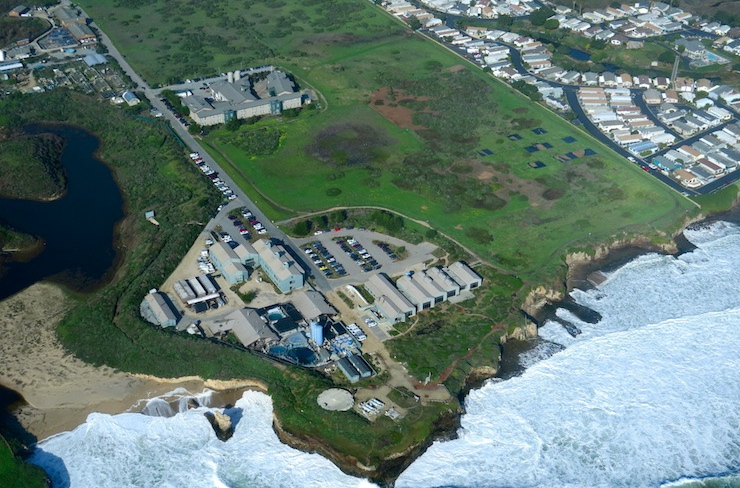
  LML aerial
  Aerial of Long Marine Lab (Lezin)

Long Marine Laboratory (LML) is an oceanside research facility located on a coastal site overlooking Monterey Bay National Marine Sanctuary. The lab provides facilities for scientists who require running seawater, large marine mammal pools, and seawater labs to conduct their research. The close proximity of the lab permits ease of integration of activities with the campus' instructional and research activities.

Approximately 100 UC Santa Cruz faculty, researchers, graduate students, and support staff have permanent space here. In addition, a number of undergraduate and graduate-level courses are taught onsite, and several visiting scientists are accommodated each year.

Long Marine Laboratory is known throughout the marine research community for innovative marine mammal research in areas such as diving physiology, physiological ecology, bioacoustics, and cognition. Active research at the lab is also conducted in the areas of nearshore invertebrate marine biology, ecology, and issues surrounding ocean health. Available facilities includes:

  • Outdoor seawater pools and pens for holding pinnipeds, sea otters, and small cetaceans
  • Seawater laboratories for fish, plankton, and marine invertebrates
  • Radioisotope labs
  • Culture lab for fish and marine invertebrate larvae and juveniles
  • Controlled photoperiod labs
  • Plankton culture labs
  • Research scuba-diving facility and small boat staging area
  • Meteorological station
  • Remote sensing surface current station (CODAR) in cooperation with NOAA
  • 1,000-gallon-per-minute seawater delivery system, wet and dry labs, and staff support

Directions to LML & the Seymour Center


[Back to Top]


-Seymour Marine Discovery Center at Long Marine Laboratory

Preschool children discovering the touch tank  
Preschool children discovering the touch tank. (Seymour Center)  

More than 52,000 public visitors, including 10,000 L-12 students come to visit the Seymour Marine Discovery Center each year, the marine lab's public education facility that focuses on interpreting marine research underway within the institute.

Opening to the public in 2000, the Seymour Center is dedicated to educating the public about marine science and ocean conservation. The Center replicates the look and feel of a working marine laboratory, with hands-on exhibits that feature the everyday tools of scientific exploration. Visitors learn about the types of questions scientists ask and get a glimpse of the processes that generate insights and understanding. The goal is to instill in visitors a deep and lasting appreciation of the role research plays in understanding and protecting the world's oceans.


-Diving and Boating Support

The institute manages the university Diving Safety Program (DSP), which is housed in an office at Long Marine Lab. The program supports scuba diving and small boats used by UCSC classes,

  Scientific Diving Class
  Scientific Diving Class (Clabuesch)

faculty, researchers, and staff in Monterey Bay and worldwide. In order to ensure safe scuba diving and scientific boating practices, the DSP provides training and oversight for all scuba diving (scientific and recreational) and scientific boating activities conducted under UCSC auspices.

IMS also manages a fleet of boats and diving equipment for researchers to gain access to nearshore, open coastal, bay, and inland habitats. Kayaks, inflatables, fiberglass, and aluminum vessels ranging from 11 to 35 feet in length are available. Portable scuba compressors and a variety of underwater sampling gear are also available for researchers and classes. UCSC is an organizational member of the American Academy of Underwater Sciences.

Boats at LML  
Boats (Clabuesch)  


Long Marine Laboratory recently celebrated it 25th anniversary in 2003, click here to check out the Long Marine Laboratory timeline.


Directions to LML & the Seymour Center

[Back to Top]


Additional Research Facilities

Scientists affiliated with the Institute of Marine Sciences have opportunities to conduct field research at four unique field locations.

  • Younger Lagoon: 1 of 33 protected reserves in the Univeristy of California Natural Reserve System. Access is restricted to research purposes. The lagoon is one of the few remaining natural wetlands along the central California coast and is an important stop for migrating birds.
  • Año Nuevo Island: 25-acre reserve located about 20 miles north of Santa Cruz, one-quarter mile from the mainland. A unique habitat heavily colonized by four species of pinnipeds numbering in the thousands, the island also supports a diverse seabird population and rich intertidal zone.
  • Landels-Hill Big Creek Reserve: 4,000 acres located on the spectacular Big Sur coast south of Monterey. This is an imporant instructional and research site for studies extending from the subtidal zone to mountain ridges.
  • San Nicolas Island Field Station: San Nicolas Island, the outermost of the Channel Islands in southern California. It is operated in cooperation with the UCSC unit of the Biological Resources Division of the U.S. Geological Survey.


[Back to Top]


Home |  Faculty & Research  |  Facilities |  In the News |  Contact Us  |  Resources  |  Long Marine Lab  |  Seymour Center
Copyright © University of California Santa Cruz. Web layout/design by Laura Beach. Last reviewed 1/24/07 by the IMS Webmaster.